
"Owned by those we serve"
A Cooperative Farming Colony Supported Depression-Era Families
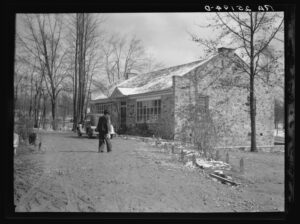
Photo credit: Library of Congress
Black and white photographs depict a hardscrabble existence at Skyline Farms — a farming cooperative community on Jackson County’s Cumberland Mountain. But, it was a life filled with family, community, music, and square dancing.
Library of Congress photo archives document the place created via a Depression-era government program. The colony put people to work as farmers, providing them with homes and land that they would then purchase through the sale of crops.
But a decade after the first residents moved in, the project ended and residents who couldn’t purchase their farms were forced to move — although many later returned to the mountain they considered home.
“Everyone in the community worked on everyone’s houses,” says Cindy Rice, the Skyline Farms Heritage Association’s historian. “That was how they built it. They literally built the whole community from the wood they cut down from the trees and the rocks they gathered.”
Today, the area where Skyline Farms once existed is the town of Skyline. The farming colony’s sandstone commissary operated as a store and gas station for decades after the cooperative was abandoned. When the store came up for sale, Rice and her husband bought it. They uncovered numerous documents associated with the colony and reached out to the Skyline Farms Heritage Association. The couple eventually sold the commissary to that group.
“What they built was an ideal community with music and dancing and churches,” Rice says. “They had people come in and teach the ladies how to sew and repair clothes. They had people come in and teach them how to can goods.”
Building a Community
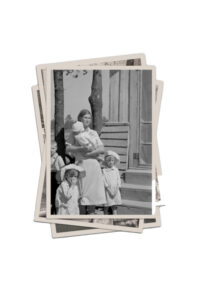
Photo credit: Prints & Photographs Division
During the Great Depression, banks failed and factories closed. By 1933, 25% of the labor force in the U.S. was unemployed. Prices and productivity fell by 1/3 of 1929 levels. People lost their homes and went hungry.
President Franklin Delano Roosevelt’s New Deal created programs like the Civilian Conservation Corps, Works Progress Administration, and the Federal Emergency Relief Administration to address the economic depression.
The Federal Emergency Relief Administration, later renamed the Resettlement Administration, created 43 cooperative farming communities around the country, including Skyline Farms.
In 1934, the federal government bought 13,000 acres on Cumberland Mountain. Skyline Farms consisted of 181 farms, each 40 to 60 acres, for families selected from relief rolls. The men were hired at 15 cents an hour to clear land, quarry for sandstone, or work in 1 of 4 sawmills.
“These families were very appreciative for anything and everything that they could get, and they were willing to work for anything and everything that they could get,” Rice says.
The men were taught carpentry, roofing, building furniture and laying stone. They built the board and batten homes along with the colony’s school, the sandstone commissary and manager’s office.
Families were provided with farming equipment and other supplies to get them started. There was a warehouse and cotton gin, and families paid a monthly fee for healthcare.
Roger Allen’s parents met at Skyline Farms. His mother was a a square dancer. His father, Chester Allen, was a singer and guitarist for The Skyline Band.
The federal government encouraged music and other arts. The families held regular square dances and movie nights. The Skyline Band even performed for the Roosevelts at a White House party in 1938. President Roosevelt reportedly slapped his knees when Chester howled like a dog during the song “Ol’ Rattler” and requested an encore.
“He was not bashful,” Allen says. “He loved music.”
Hard Times
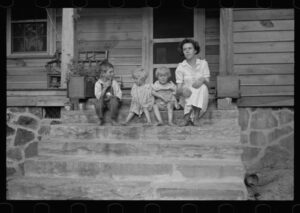
Photo credit: Farm Security
In the early 1940s, Skyline Farms hit its share of challenges. Cotton and potato crops failed in the North Alabama climate. A hosiery mill constructed by the government to boost the local economy also failed when World War II created a nylon shortage.
By 1944, there were congressional concerns that the cooperative colonies promoted socialism. When the federal government began liquidating the colonies in 1945, only 2 of the original Skyline families could afford to buy their farms outright.
It was not the ending residents expected as properties were sold to other private buyers. While circumstances forced most of the residents to move, many eventually returned to Skyline.
The sandstone commissary is now a museum operated by the Heritage Association, which is restoring the former manager’s office and has preserved 1 of the original colony homes. The old hosiery mill is now home to Buccaneer Rope Company.
A stone school — built after the original wood structure burned — is still a school and is listed on the Alabama Register of Historic Places. The threat of the school being torn down for a modern facility revived interest in protecting the history of Skyline Farms.
While Allen’s family had to move away, his parents returned and remained in Skyline until their deaths. Allen grew up near the “rock store,” as the commissary was known. His mother would host quilters in their living room, while his father entertained on the front porch.
A member of the heritage association, Allen was among those who fought to save the school.
“It’s just a part of me, close to me,” Allen says. “It was just so important to my family and to me growing up. It’s like the ocean — you go to the ocean and it’s like it’s calling you out to it.”