
"Owned by those we serve"
Campers Pampered at Graham Farm & Nature Center
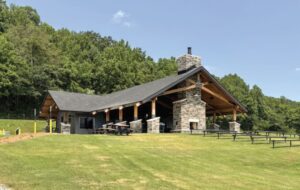
A 4,200-square-foot pavilion near the wagon campsites houses restrooms and showers, plus an expansive covered patio, open fireplace, commercial kitchen and meeting rooms.
2 eye-catching Conestoga wagons might make Graham Farm and Nature Center visitors wonder if they stumbled upon a campsite along the Oregon Trail instead of in Alabama’s Paint Rock Valley. But other than their distinctive look, these wagons have little in common with their rugged predecessors.
How did wagons that helped settle the West find a home near Estillfork? A couple of years ago, Graham Farm and Nature Center Director Themika Sims heard about Conestoga being used in the Midwest as a unique camping option. “I did a little research on them, talked to my business office about the potential of purchasing a couple, made the contacts, and then we just made it happen from there,” Sims says.
The wagons are crafted for glamping by Idaho-based Conestoga Wagon Co. The exterior maintains classic Conestoga design, with fully functioning wheels and a double-domed, arching canvas.
Inside, though, it’s a different story. Each wagon features a king-size bed, twin bunk beds, a wagon wheel table with chairs, a mini refrigerator, microwave, coffee maker, and full climate control through a mini-split heating and cooling unit. Campers can sit outside in Adirondack chairs, under the shelter of a shade cloth, to enjoy their own gas fire pit and spectacular scenery.
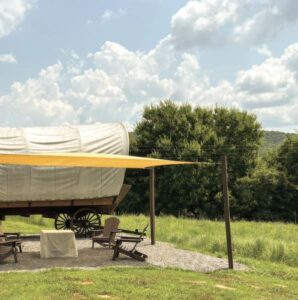
Each wagon campsite has its own outdoor seating and gas fire pit.
A few steps from the wagons is a new 4,200-square-foot pavilion housing restrooms and showers, a large covered patio with seating and an open fireplace, an enclosed commercial kitchen, and meeting rooms. Completed in 2024, the building serves campers but also hosts outreach and educational programs offered by the Alabama Cooperative Extension System, which owns and oversees Graham Farm and Nature Center.
The farm also offers three large canvas bell tents that further accommodate what Sims and his team call “pampered camping.” Like the wagons, the tents have full climate control for year-round use, plus luxury touches like fine bed linens, cozy rugs, string lights, and seasonal decor.
Recreational options on the nearly 500-acre farm include hiking and mountain biking on 8.5 miles of trails, birding, fishing, touring historic buildings that date to the 1800s, stargazing under dark skies, and even kayaking or canoeing, since the property sits at the confluence of the Paint Rock River and Larkin Fork Creek.
From the launch at the wildlife management area upstream, boaters can expect about a two-hour float. “Depending on the time of year, the flow rate and how much rain we receive, you may have to drag a little bit when the water is down, but it’s just part of the experience,” Sims says. “It’s a good little float.”
Ships of the Land
Conestoga wagons date back to early-1700s Pennsylvania, where the basic colonial farm wagon was transformed into a rugged overland freight hauler. The Conestoga’s unique sloping bed prevented cargo from shifting as the wagon bounced along rough dirt roads, and the canvas cover stretched across large wooden bows protected freight from the weather.
The wagons became essential in military campaigns before and during the American Revolution and the War of 1812 and then were the first “big rigs,” hauling much of the nation’s long-distance freight. By the late 1800s, pushed aside by railroads and canals, they became the moving van of choice for families heading to the Great Plains and Pacific Coast.
Family Focus
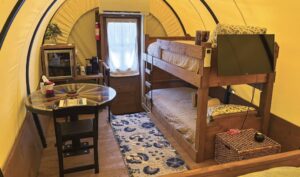
Inside the Conestoga wagons at Graham Farm and Nature Center are a king-sized bed, twin bunk beds, full climate control and other modern comforts.
The Graham Farm and Nature Center focuses on educational outreach, following the wishes of Nita Graham Head and her husband, Robert, who donated the property to ACES. The couple, both educators, decided that, since they had no heirs, they would trust local extension representatives to establish their desired legacy of sharing historical and natural resource education with the community.
Nita Graham Head was born and raised in the house on the farm, located at 420 County Road 27, and owned by her family for 81 years. Her intention in donating it to ACES was that it be used to teach the public about natural resources conservation, animal science education, ecology, historical preservation, youth development, oral history, wildlife management, ornithology, aquatics, and fruit and vegetable production.
Sims saw Graham Farm and Nature Center’s potential for recreational opportunities alongside its educational role. “Our motto is ‘Why go to Gatlinburg when you can come to Paint Rock?’ So, we try to keep true to that,” he says. “We have all the amenities a person enjoys in camping — swimming, kayaking, birding — we have all kinds of outdoor recreational activities here at the farm.”
Website, reservation system, and security updates are ongoing to better serve campers, but the farm is also welcoming some new permanent residents. “We’re in the process of getting some chickens and rabbits, and there are cattle here that belong to one of the local farmers,” Sims says. “As for security, everything here is electronic access, even the gates we’re installing. We give campers passcodes to unlock the gates, access to the restrooms and such, and we also have cameras.”
For more information on Graham Farm and Nature Center or the programs offered there, visit the center’s Facebook page or website.
“We encourage families to come here,” Sims says. “You know, it’s all about getting out and enjoying.”