Welcome to the Engineering and Operations section of our website!
Information in this section is intended to better familiarize you with our policies and procedures, as well as serve as an excellent resource whenever you have questions about your electric hookup.
Distribution Systems
NAEC operates and maintains approximately 2000 miles of distribution lines in Jackson and Marshall Counties in Alabama. The power is delivered to its customers via 7 substations NAEC owns and/or maintains.
We at NAEC are ever striving to improve the system to maintain reliable service to its consumers. Even with this we cannot guarantee your power will always be on. Just like everything in life, the distribution system is affected by many different problems occurring often at a very inconvenient time. Things creating problems for the distribution system include weather, animals, equipment problems or failure, trees and vines, etc. All of the above have an effect on providing electrical service to you.
NAEC is continuing to install additional sectionalizing equipment to help reduce the number of customers affected for certain outages. Lightning arresters are being installed to help reduce the number of lightning related outages.
We are continuing to improve our mapping and outage management systems in order to help us determine where outages are occurring. This helps us make better decisions on where to dispatch crews.
Before You Dig
Call Alabama 811 before you dig.
The Benefits of Digging Safely
Digging, trenching, boring, augering, and blasting are all inherently dangerous to life and property. Even under ideal conditions with a minimum of underground utilities or other obstructions, the risk of potential damage is high. Unintentional damage to underground facilities during excavation is a significant cause of disruption in telecommunications, water supply, electric power and other vital public services, such as hospitals and air traffic control operations, and is a leading cause of natural gas and hazardous liquid pipeline accidents. Coordination, communication and cooperation between excavators, contractors, homeowners, and utility owners can reduce the risk of damage to utility facilities.
When a contractor, excavator or homeowner plans their work, works their plan and calls for underground utility locates in a timely manner, there are many benefits for all to realize:
- Reduce the chance of personal injury to employees and citizens.
- Maintain uninterrupted utility service to the citizens of Alabama.
- Reduce insurance premium payments.
- Reduce Worker’s Compensation payments.
- Reduce non-productive down time.
- Optimize job-scheduling activities.
- Reduce overtime payments.
- Reduce damages to expensive excavating equipment.
- Reduce or eliminate the payment of property damage claims.
Right of Way
Our Right of Way department is more affectionately known to our members as the Tree Trimming Department because sometimes we have to trim trees around power lines to help ensure that your power and your neighbors’ power will not be interrupted.
Each NAEC member agrees in the membership application to grant us a Right of Way easement, giving us permission to cut and keep clear all trees within an unsafe distance from the power lines.
NAEC uses pruning techniques that are recommended by the International Society of Arboriculture, the American National Standards Institute, and the National Arbor Day Foundation to ensure the health of your trees.
Right of Way Policies
- Routine Right of Way clearing activities will be performed to accomplish a 4-year clearing cycle to maximize productivity, maximize benefits from Right of Way funding, and minimize power interruptions.
- During routine Right of Way maintenance, all trees within the Right of Way will be removed wherever possible. Right of Way width for single-phase lines is 30 feet and 40 feet for three-phase lines.
- Fifteen feet of clearance between trees and energized conductors will be maintained. In special situations, a minimum clearance of 10 feet must be obtained.
- Trees around secondary or service lines will be trimmed to provide only three feet of clearance and only during routine maintenance activities. No trimming will be done on service lines between trimming cycles unless limbs are exerting excessive pressure on the lines.
- NAEC will not cut trees, healthy or dead, around service lines. NAEC will have the line disconnected so that the property owner may have the tree cut.
- Trees outside of NAEC’s Right of Way will not be cut unless the trees are determined by NAEC to be endangering primary power lines or the removal of these trees will significantly benefit the reliability of electrical power or reduce future Right of Way clearance costs.
- Property owners will be responsible for hiring qualified tree removal personnel to safely remove trees adjacent to NAEC power line Right of Ways.
- Dead trees will be cut only if they pose a significant threat to primary power lines. Dead trees cut to protect power lines will not be cleaned up.
- Trimming requests submitted by NAEC personnel and by customers will be investigated and work will be done if it is warranted. Trees causing power interruptions will be trimmed before any other tree trimming work is performed. Trees determined not to be an immediate threat to electrical power distribution or public safety will not be trimmed until scheduled routine maintenance.
- Trees will be trimmed in accordance with the tree trimming methods approved by the National Arborists Association, the American National Standards Institute, and the National Arbor Day Foundation, to promote tree health and to reduce re-sprouting. Names for this type of pruning include “the Shiago Method”, Drop-Crotch Pruning, and Directional Pruning.
- Stumps of all trees cut by hand will be treated with an approved herbicide to prevent re-sprouting.
- Brush and debris from tree trimming and Right of Way clearing activities will be cleaned up only in actively maintained areas. In non-maintained areas, brush and debris will mowed during routine maintenance or hand-cut into smaller pieces and left on site.
- Brush and debris due to storms or power outages will not be cleaned up.
- Dead brush from herbicide application will not be cut down or cleaned up.
Tree Trimming
Electric utility companies are responsible for delivering quality power as safely and inexpensively as possible, and sometimes trees can present a major obstacle to meeting those responsibilities. Power interruptions and safety hazards caused by trees can be avoided while preserving the tree’s health and beauty by utilizing good tree pruning methods or the removal and replanting of the “right tree in the right place.”
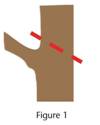
NAEC uses pruning techniques that are recommended by the International Society of Arboriculture, the American National Standards Institute, and the National Arbor Day Foundation. This means that vertical tree stems and horizontal branches are cut at the fork where the branch meets the trunk or other branches (see figure 1). This pruning method speeds wound closure, reduces sprout growth, and ultimately directs future limb growth away from the wires. As a result, power outages are reduced and maintenance costs are lowered because properly pruned trees require less frequent pruning.
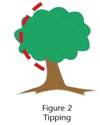
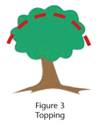
Before these new pruning standards were adopted, several pruners used the “tipping” or “topping” methods to prune problematic trees. Tipping involves the removal of the tips of the side branches of the tree (figure 2), and topping involves removing the top and upright branches of the tree (figure 3). Roundover occurs when the pruner uses tipping and topping to prune the tree into a rounded shape. These forms of pruning are discouraged because they lead to excessive sprouting, cracks, rotting, branch and trunk failure, and the premature death of the tree.
Another common problem that NAEC utility foresters encounter is the presence of large-growing trees near power lines. Many of these large trees must be pruned so heavily and frequently that they ultimately decline, decay, and come a hazard. The long-term solution to this problem is to select and plant trees whose mature height and spread will not interfere with nearby utility lines. Trees such as dogwoods, peach trees, and Japanese maples whose height does not exceed 15 feet at maturity are recommended, along with crape myrtles and other low-growing shrubs.
Finally, always ask the location of any underground utilities before planting a tree. This is very important so that you do not accidentally dig into any lines and risk injury or service interruption. To find out if you’re planting in a safe area, make the free phone call to 1-800-572-2900.